

FFA, TROSA, and ADPC Launch New Report Calling on Climate Funds and Governments to Remove Climate Finance Barriers for Asian Communities
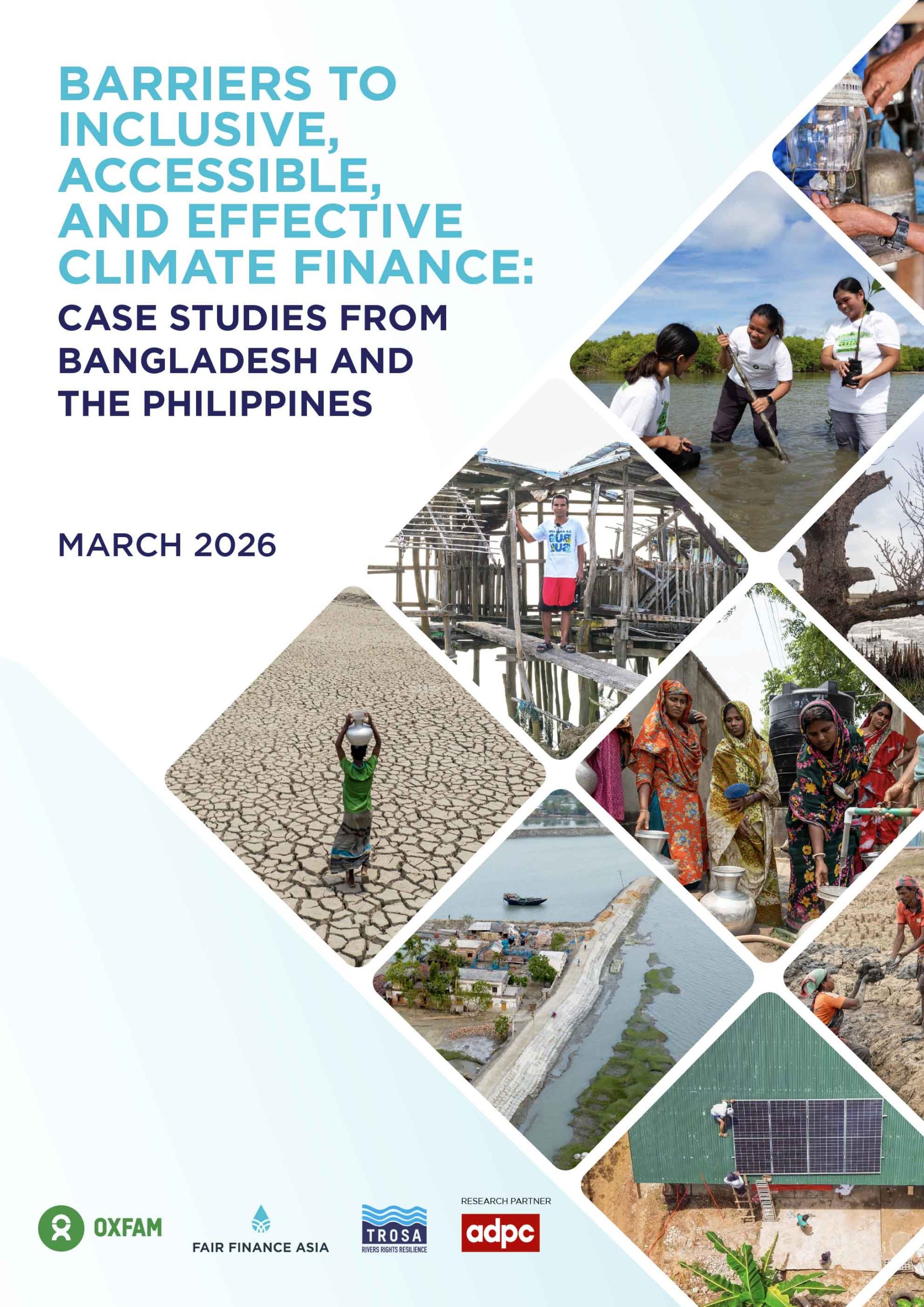
Fair Finance Asia, Transboundary Rivers of South Asia, and Asian Disaster Preparedness Center (2026, March), Barriers to Inclusive, Accessible, and Effective Climate Finance: Case Studies from Bangladesh and the Philippines.
Oxfam’s Fair Finance Asia (FFA) and Transboundary Rivers of South Asia (TROSA) Programs, together with research partner, Asia Disaster Preparedness Center (ADPC), have launched a report exposing critical barriers that prevent climate finance from effectively reaching frontline communities in Bangladesh and the Philippines. The two countries are amongst the most climate-exposed nations in Asia and largest recipients of global climate funding. This report was developed in collaboration with Fair Finance Bangladesh, Fair Finance Philippines, Oxfam in Bangladesh, Oxfam Pilipinas, and Rangpur Dinajpur Rural Services Bangladesh (RDRS).
The report, Barriers to Inclusive, Accessible, and Effective Climate Finance: Case Studies from Bangladesh and the Philippines, found that Bangladesh received USD 21.1 billion and the Philippines USD 15.9 billion in climate finance from 2016 to 2022, respectively. More than 90% of this funding came as loans rather than grants, exacerbating the debt burden of both countries. The report reveals serious gaps in climate finance effectiveness: while funding volumes increase, access remains highly unequal. Farmers, coastal communities, low-income households, and other groups disproportionately affected by recurring climate-induced disasters are often excluded from decision-making and benefit minimally from available finance.
The report found key structural barriers faced by frontline communities:
- Over-reliance on intermediaries, such as multilateral agencies, increases costs and limits national ownership.
- Limited direct access to global funds like the Green Climate Fund (GCF) due to insufficient accredited institutions.
- Debt-heavy financing models strain public budgets and divert resources from adaptation.
- Weak inclusion mechanisms, where women, Indigenous Peoples, and marginalized groups are rarely involved in decision-making.
Based on the report’s assessment of 40 climate projects (20 in each country), gender and inclusion policies often focus on participation numbers rather than addressing underlying power imbalances or promoting gender-sensitive budgeting. While most projects incorporate some form of gender mainstreaming, fewer than 40% of those reviewed in Bangladesh and the Philippines explicitly include Indigenous Peoples.
Case studies of three GCF projects highlight both risks and potential. In Bangladesh, the Climate Change Project-Drought (ECCCP-Drought) and Extended Community Climate Change Project-Flood (ECCCP-Flood) projects combine grants with local civil society engagement and demonstrate tangible benefits, including climate-resilient housing, improved sanitation, and adaptive agriculture. Their loan-heavy approaches, however, risk increasing financial pressure on already vulnerable households. In the Philippines, Climate Investor Two (CI2) successfully mobilized private investment, but prioritizes infrastructure over community-based adaptation and lacks robust social and environmental safeguards.
The report calls for urgent reforms to ensure climate finance delivers real impact for Asian communities that need it the most:
- Shift from loans to grant-based financing, especially for adaptation.
- Decentralize access and strengthen national and local institutions.
- Guarantee formal community leadership in planning and implementation.
- Strengthen transparency and accountability with open tracking systems, citizen audits, and community scorecards.
- Advance equity, affordability, gender justice, and inclusion.
Access the full report and recommendations here.
More information:
- Learn more about FFA-TROSA’s climate finance dialogue at World Water Week (WWW) 2025 here.
- Access Just Energy Transition (JET) Toolkit by Oxfam’s FFA and Influencing Just Energy Transition in ASEAN (IJET) Programs here.