

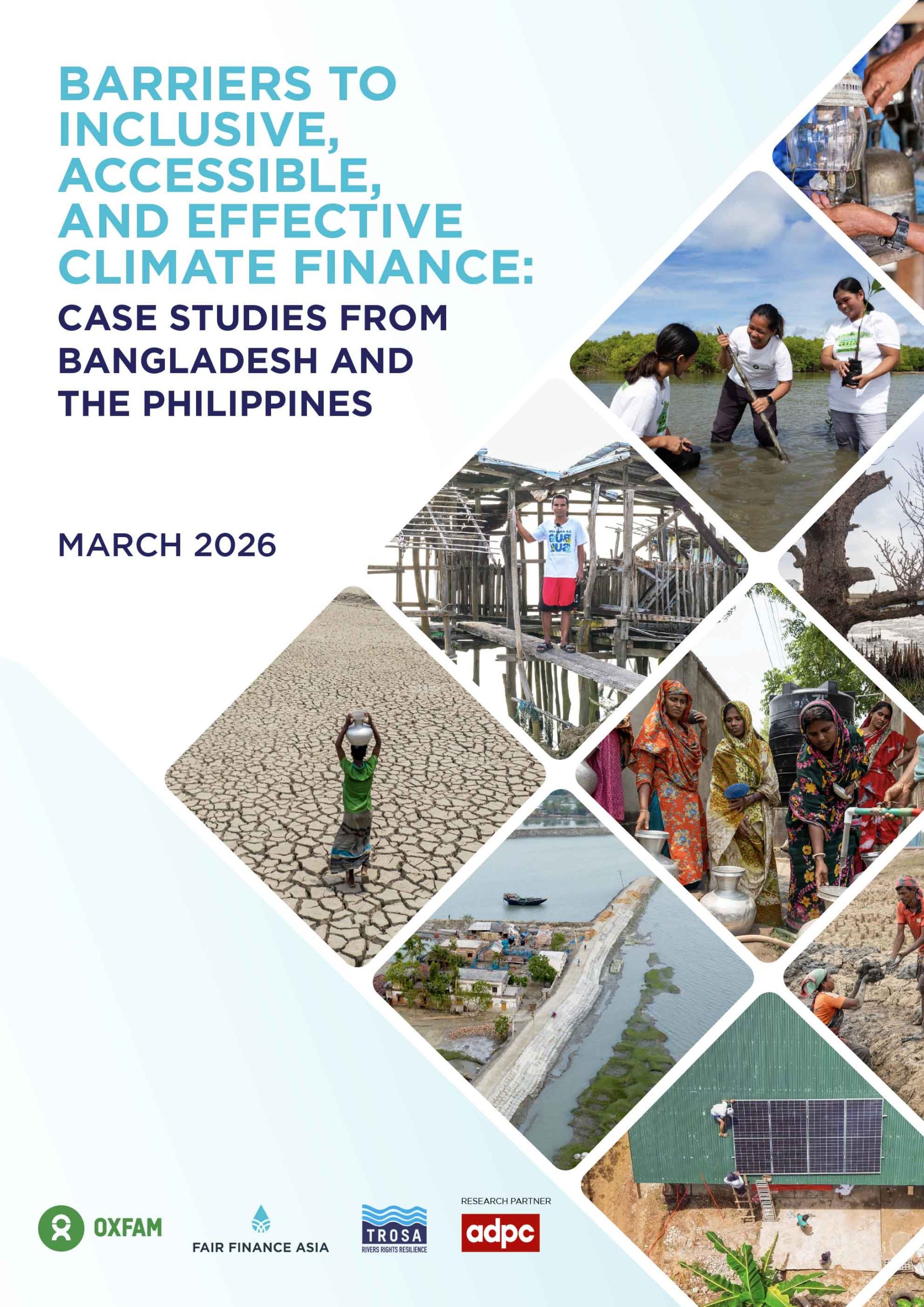
PHNOM PENH, CAMBODIA, March 26, 2025 – Oxfam’s Fair Finance Asia (FFA) and Transboundary Rivers of South Asia (TROSA) Programs, together with research partner, Asia Disaster Preparedness Center (ADPC), have launched a report exposing critical barriers that prevent climate finance from effectively reaching frontline communities in Bangladesh and the Philippines. The two countries are amongst the most climate-exposed nations in Asia and largest recipients of global climate funding. This report was developed in collaboration with Fair Finance Bangladesh, Fair Finance Philippines, Oxfam in Bangladesh, Oxfam Pilipinas, and Rangpur Dinajpur Rural Services Bangladesh (RDRS).
The report, Barriers to Inclusive, Accessible, and Effective Climate Finance: Case Studies from Bangladesh and the Philippines, found that Bangladesh received USD 21.1 billion and the Philippines USD 15.9 billion in climate finance from 2016 to 2022, respectively. More than 90% of this funding came as loans rather than grants, exacerbating the debt burden of both countries. The report reveals serious gaps in climate finance effectiveness: while funding volumes increase, access remains highly unequal. Farmers, coastal communities, low-income households, and other groups disproportionately affected by recurring climate-induced disasters are often excluded from decision-making and benefit minimally from available finance.
The report found key structural barriers faced by frontline communities:
- Over-reliance on intermediaries, such as multilateral agencies, increases costs and limits national ownership.
- Limited direct access to global funds like the Green Climate Fund (GCF) due to insufficient accredited institutions.
- Debt-heavy financing models strain public budgets and divert resources from adaptation.
- Weak inclusion mechanisms, where women, Indigenous Peoples, and marginalized groups are rarely involved in decision-making.
Based on the report’s assessment of 40 climate projects (20 in each country), gender and inclusion policies often focus on participation numbers rather than addressing underlying power imbalances or promoting gender-sensitive budgeting. While most projects incorporate some form of gender mainstreaming, fewer than 40% of those reviewed in Bangladesh and the Philippines explicitly include Indigenous Peoples.
Case studies of three GCF projects highlight both risks and potential. In Bangladesh, the Climate Change Project-Drought (ECCCP-Drought) and Extended Community Climate Change Project-Flood (ECCCP-Flood) projects combine grants with local civil society engagement and demonstrate tangible benefits, including climate-resilient housing, improved sanitation, and adaptive agriculture. Their loan-heavy approaches, however, risk increasing financial pressure on already vulnerable households. In the Philippines, Climate Investor Two (CI2) successfully mobilized private investment, but prioritizes infrastructure over community-based adaptation and lacks robust social and environmental safeguards.
The report calls for urgent reforms to ensure climate finance delivers real impact for Asian communities that need it the most:
- Shift from loans to grant-based financing, especially for adaptation.
- Decentralize access and strengthen national and local institutions.
- Guarantee formal community leadership in planning and implementation.
- Strengthen transparency and accountability with open tracking systems, citizen audits, and community scorecards.
- Advance equity, affordability, gender justice, and inclusion.
“Climate finance is crucial for achieving climate justice for communities, but climate finance justice itself is a two-way ecosystem. First, it requires mobilizing climate finance from national and international sources through strong, evidence-based accounts that span adaptation, loss and damage costs, and response costs. Second, it demands the allocation and disbursement of climate finance to the true rightsholders for the real causes, ensuring inclusivity and keeping climate-vulnerable communities at the center,” said Ashish Damle, Country Director, Oxfam in Bangladesh.
“The research once again highlights the stark realities of the current climate finance structure—that rigid procedures and mechanisms still favor international intermediaries and private investors over local and community actors who need it most. The report is a timely call, not only to the GCF Board and secretariat, but to all climate finance facilities out there, to re-evaluate and re-center its mechanisms and procedures towards real community benefits and empowerment,” said Maria Rosario “Lot” Felizco, Executive Director, Oxfam Pilipinas.
“Across Asia, frontline communities are bearing the brunt of a crisis they didn’t cause, yet climate finance mechanisms continue to exclude them. We see a consistent pattern: funds delivery channels are too slow, too complex, and too debt-driven to meet community needs. Climate finance has to undergo a redesign to prioritize grants, shift power to national and local actors, and ensure communities are not just beneficiaries, but decision-makers on equal footing. Without this shift, climate finance risks becoming another tool for deepening inequality instead of building resilience among the most vulnerable,” said Bernadette Victorio, Program Lead, Fair Finance Asia.
“Communities in South Asia’s shared river systems, hold deep knowledge of local risks, yet they remain at the margins of funding decisions that directly affect their lives. Climate resilience for such communities is only possible when they are actively involved in designing, implementing, and monitoring adaptation projects,” said Dr. Veena Vidyadharan, Feminist Influencing Lead, Transboundary Rivers of South Asia, Oxfam International Asia.
“While frontline communities in the Philippines are living with the daily impacts of the climate crisis such as typhoons, coastal erosion, and flooding, the financial support meant to help them adapt rarely reaches the ground. Climate finance must move faster and reach the people who are already dealing with the consequences of climate change. All important players including the donors, the private sector, civil society organizations, and the Philippine government must ensure that resources are accessible, transparent, and truly responsive to local needs,” said Andrew Leonardo, Project Lead, Fair Finance Philippines, The Initiatives for Dialogue and Empowerment through Alternative Legal Services.
“Climate finance must ultimately reach frontline communities—those who face climate impacts first and recover last. The report shows that while global commitments are increasing, structural barriers continue to limit access for local actors. Addressing this gap requires stronger involvement of national institutions, transparent funding flows, and partnerships that empower communities to lead adaptation efforts. Climate finance must go beyond global commitments and avoid debt-laden structures. It needs to be designed to be accessible and just for the most vulnerable countries, while empowering communities living with climate risks every day,” said Muhammad Didi, Climate Finance Specialist, Asian Disaster Preparedness Center.
Access the full report and recommendations here.
FOR FURTHER INQUIRIES, CONTACT:
Kyle Cruz
Influencing and Campaigning Manager
Fair Finance Asia
Grishma Raj Aryal
Communications Coordinator
Transboundary Rivers of South Asia
NOTE TO EDITORS
About FFA
FFA is a regional network of Asian civil society organizations committed to ensuring that the business decisions and funding strategies of financial institutions in the region respect the social and environmental well-being of the communities in which they operate. Civil society coalitions from 10 countries are part of the FFA network: Bangladesh, Cambodia, India, Indonesia, Japan, Lao PDR, Pakistan, the Philippines, Thailand, and Vietnam. To learn more about FFA, visit: www.fairfinanceasia.org
About TROSA
Transboundary Rivers of South Asia (TROSA), implemented by Oxfam and its partners with support from the Government of Sweden since 2017, works for just and inclusive governance of transboundary rivers. Since December 2022, the program has started its second phase, which focuses on strengthening cooperation in governing shared water resources and enhancing the resilience of riparian communities to climate change in the Ganges-Brahmaputra-Meghna (GBM) River basins. The program has a layered partnership arrangement with six regional partners and 11 national partners engaged at the regional, national, and local levels. To learn more, visit: https://asia.oxfam.org/what-we-do/water-governance-transboundary-rivers-south-asia